Swimming For Spinal Conditions And IVDD
For owners of dogs with a spinal diagnosis or IVDD history whose vet has raised swimming as part of a management plan.
A spinal diagnosis, particularly Intervertebral Disc Disease (IVDD), is worrying for any owner, and questions about exercise afterwards are common — what's safe, what isn't, and whether swimming genuinely helps or carries its own risks. Because spinal conditions vary enormously in severity and stage of healing, there is no single answer that applies to every dog.
This guide sets out how we approach swimming for dogs with a spinal history, and it comes with one condition that overrides everything else here: vet clearance is essential before any spinal or IVDD dog enters our pool. We are not vets and we don't diagnose, assess spinal stability or advise on surgical versus conservative management — that decision sits entirely with your vet or veterinary neurologist.
What we can offer, once your vet has confirmed water exercise is appropriate, is a warm, private, low-impact pool where movement can be supported and controlled rather than forced.
Key points
- Vet clearance is required before any spinal or IVDD dog swims — no exceptions.
- Warm water and buoyancy can support gentle movement with reduced load on the spine, once cleared by a vet.
- Swim Coach sessions, with one of our team in the water throughout, are the standard starting point for these cases.
Why vet clearance comes before anything else
IVDD and other spinal conditions cover a wide range of severity, from a mild, stable disc bulge to acute disc herniation requiring emergency surgery. The stage of recovery, whether surgery has taken place, and how stable the spine currently is all determine what movement, if any, is appropriate — and only your vet has that clinical picture.
Swimming too early, or without the right precautions, in a dog with an unstable spine could worsen the underlying problem. This is why we always require confirmation from your vet that water-based exercise is appropriate before booking a session for any dog with a spinal history, and we ask for details of any specific restrictions your vet has given.
Why warm water is often part of a management plan
Once a vet has given the go-ahead, warm water is frequently used as part of spinal rehabilitation because buoyancy reduces the load on the spine and limbs compared with walking or standing on land, while still allowing controlled movement. Our pool water is held between 28 and 32°C, which supports gentle muscle activity without the discomfort colder water can cause in an already sensitive dog.
The reduced load matters particularly for dogs regaining strength and coordination after a period of confinement or surgery, since land-based movement at that stage may be more than the spine or supporting muscles can safely manage, whereas supported movement in water can be a gentler stepping stone.
What a typical spinal or IVDD swim looks like
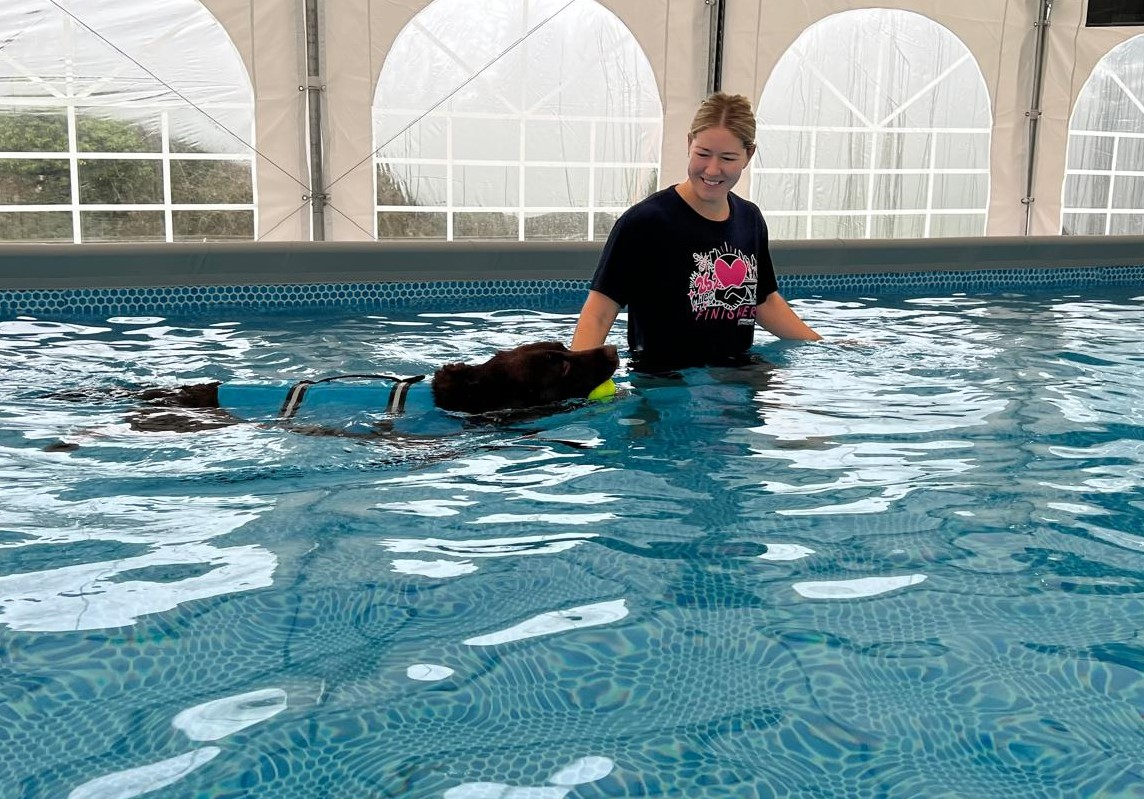
These are always Swim Coach sessions, with one of our team in the water alongside your dog for the full 30 minutes, providing hands-on support and controlling the pace and range of movement rather than leaving your dog to swim freely. This close support is essential for a dog whose stability and coordination may still be recovering.
Sessions typically start gently — supported standing, very controlled paddling, short bursts — and only progress if your dog is coping well and your vet is comfortable with that progression. There is no set timetable; pace is dictated entirely by how the individual dog responds, in line with your vet's guidance.
Information we need before a spinal or IVDD session
The more detail we have, the more safely we can plan the session.
- The diagnosis and, if relevant, the disc level or region affected.
- Whether surgery has taken place, and the date.
- Confirmation from your vet that water exercise is currently appropriate.
- Any restrictions on movement, positioning or duration your vet has specified.
- Current mobility — whether your dog is walking unaided, using support, or has residual weakness.
Signs we watch for during a session
Our team keeps a close eye on how a spinal or IVDD dog responds throughout a session — any sign of distress, unusual weakness, loss of coordination or reluctance to move is taken seriously, and the session is adjusted or stopped if needed. We are working within the framework your vet has set, not pushing beyond it.
If you notice any change in your dog's condition between sessions — new weakness, pain, or a change in bladder or bowel control, which can be significant with spinal conditions — that needs to go to your vet immediately, and swimming should be paused until they've assessed the change.
Longer-term use as condition stabilises
For dogs whose spinal condition has stabilised and who are progressing well under veterinary guidance, swimming can become a regular part of an ongoing management or maintenance plan, since the low-impact nature of water exercise suits a spine that needs to avoid repeated jarring movement long-term. Session frequency and progression should still be agreed with your vet as your dog's condition evolves.
Some owners continue with Swim Coach long-term for the reassurance of hands-on support; others move toward Owner In Pool once both they and their vet are confident in the dog's stability. That transition is a conversation to have with us and with your vet together, not something to decide unilaterally.
Common questions
Can I book a swim for my IVDD dog without vet clearance?
No. We require vet confirmation that water exercise is appropriate before any spinal or IVDD dog enters the pool.
Is Swim Coach compulsory for spinal or IVDD dogs?
Yes, this is our standard approach — one of our team is in the water throughout to provide hands-on support and control movement.
How soon after IVDD surgery can a dog swim?
This depends entirely on your vet's assessment of healing and spinal stability. There's no general timeframe — always get specific clearance first.
What if my dog shows discomfort during a session?
We stop or adjust immediately. Any sign of distress, new weakness or reluctance to move is taken seriously and reported back to you to raise with your vet.
Can a stable, long-term IVDD dog swim regularly?
Often yes, once your vet is comfortable with ongoing water exercise as part of a maintenance plan — session frequency should still be agreed with your vet.
Book a vet-cleared spinal support session
Call 07359 881320 with your vet's guidance and we'll arrange a supported Swim Coach session.
What Happens Next?
- 1. We review your enquiry
- 2. We call or text to confirm
- 3. Bring your dog and a towel!
Related guides
Vet referral process
For owners whose vet has suggested swimming, or who need to know whether a referral is required before booking.
Use caseCruciate recovery swimming
For owners of dogs recovering from cruciate ligament injury or surgery, looking for vet-approved exercise options.
ProcessSwimming after surgery
For owners whose dog is recovering from an operation.