Swimming Pool vs Underwater Treadmill For Dogs
For owners choosing between a pool and a treadmill facility.
Both put a dog in warm water and both reduce load on the joints, but they ask for completely different movement. Choosing between them comes down to what you want the water to do.
Here is how the two compare, honestly, including where a treadmill has the edge over a pool.
Key points
- Swimming is non-weight-bearing and works the whole body freely.
- A treadmill keeps a dog upright and rehearses a walking gait.
- We run a pool — for gait-specific work, a treadmill facility may fit better.
How swimming works the body
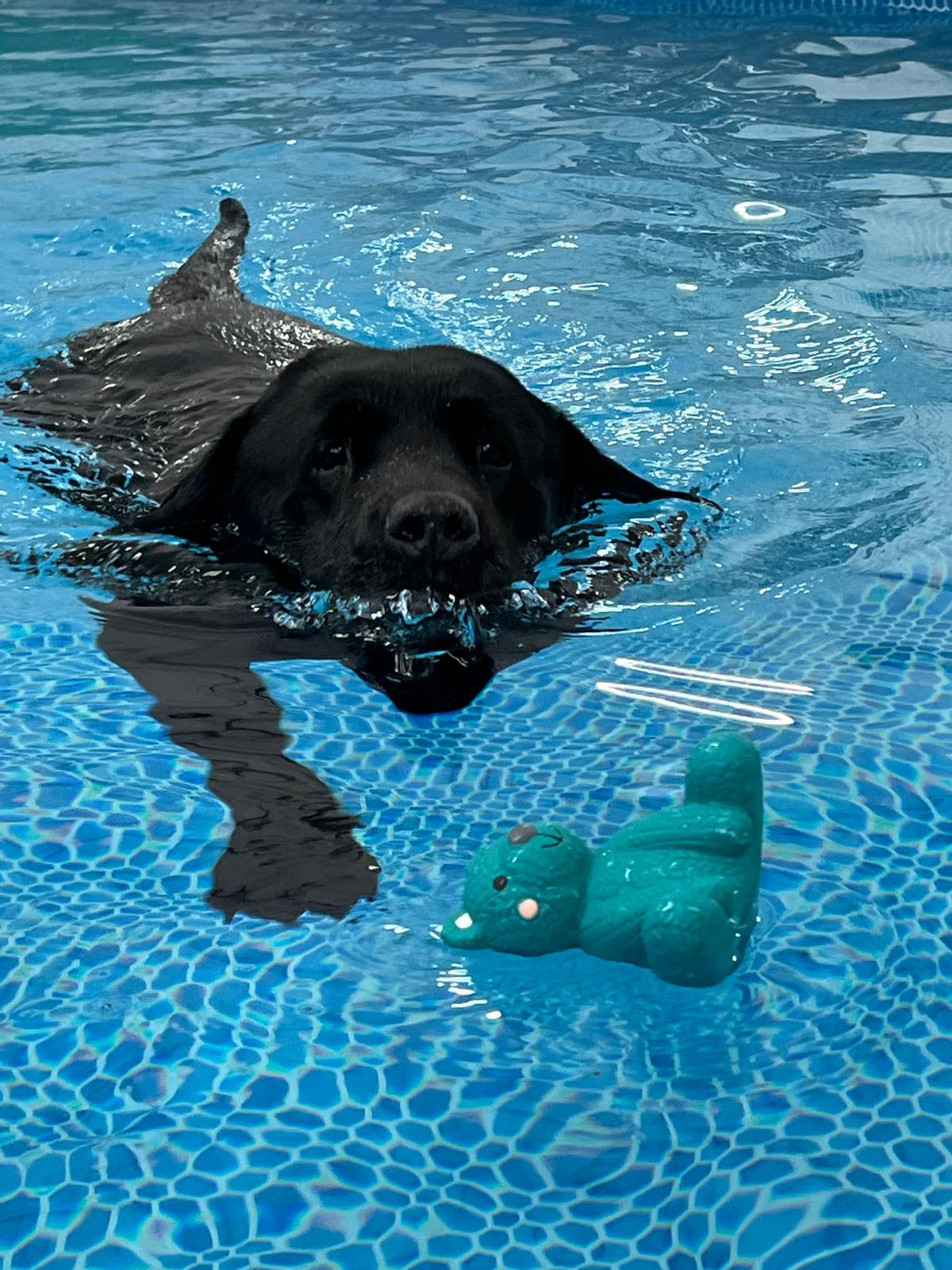
In a pool a dog is fully supported by the water, with no impact through the limbs at all. The stroke pattern uses shoulders, back, core and hind limbs through a large range of movement, and the resistance comes from the water in every direction.
That makes swimming strong for cardiovascular fitness, calorie burn, general muscle condition and burning off energy — and kind to sore joints because nothing lands.
How a water treadmill works the body
On an underwater treadmill the dog stays upright and walks, with water taking part of their body weight. The movement pattern is a walking gait rather than a swimming stroke, and depth can be adjusted to change how much weight the limbs carry.
That precision is its strength: it rehearses the exact motion a dog uses on land, which matters when the goal is to correct or rebuild a normal walking pattern.
Choosing between them
Neither is better in the abstract. They suit different goals.
- Fitness, weight loss, energy burn, whole-body conditioning — a pool.
- Water confidence and enjoyment — a pool, every time.
- Rebuilding a specific walking gait under clinical supervision — a treadmill.
- Dogs who genuinely dislike swimming but tolerate walking — a treadmill.
What we offer
We run a heated indoor pool at Bretherton, not a water treadmill. Sessions are private, 30 minutes, in water between 28 and 32°C, with buoyancy aids and a coach in the water when that helps.
If your vet has specifically asked for gait-focused treadmill work, a facility with that equipment is the better call — and we would rather tell you that than sell you the wrong session.
Common questions
Is swimming or a treadmill better for arthritis?
Both reduce joint load. Swimming removes impact entirely, which many stiff dogs find easier; a treadmill offers finer control of how much weight the limbs take. Your vet's view on your dog's specific joints should decide it.
Do you have an underwater treadmill?
No — we run a heated indoor swimming pool. We'll say so plainly if treadmill work is what your dog needs.
Which burns more energy?
Swimming is typically the harder cardiovascular workout, which is why first sessions are built from short bursts with rests.
Can a dog use both?
Yes, and some rehabilitation plans do exactly that — treadmill work for gait, swimming for fitness and enjoyment.
Book a pool session
Tell us your goal and we'll recommend the session type — or point you elsewhere if a pool isn't the right tool.
What Happens Next?
- 1. We review your enquiry
- 2. We call or text to confirm
- 3. Bring your dog and a towel!
Related guides
Hydrotherapy vs recreational swimming
For owners told their dog 'needs hydrotherapy' and unsure what to book.
ProcessSwimming after surgery
For owners whose dog is recovering from an operation.
ProcessWeight-loss swimming plan
For owners of overweight dogs who struggle with land-based exercise.